

Moore’s Law, developed by Gordon Moore (one of Intel’s cofounders) in 1965, concludes there is a pattern in the development of technology. Specifically, he believed that the technology in computer processors would continue to advance and double every two years. Moore’s theory was so accurate that it was nicknamed as Moore’s Law. Moore believed Semiconductors would allow more and more components to be added to each chip, decreasing the size and increasing the processing speed of computers. Moore’s Law continues to be accurate today, some say the rate is more likely to be every 18 months that technology is being refined.
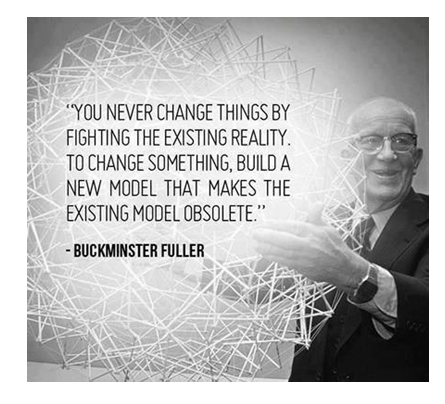
Buckminster Fuller was an inventory and visionary comprehensive anticipatory design scientist to solve global problems. Fuller developed a theory of Knowledge Doubling. This idea basically states that human ingenuity has allowed for the development of technology. This development has accelerated the rate at which knowledge can be shared around the world. Buckminster rejected the idea put forth by Thomas Malthus that the population growth was outpacing food production growth. Malthus’ theory has been applied to all fields of production, creating the common belief that there will always be those who must go without. Buckminster felt that human ingenuity would conquer these limitations and solutions would be found. He states believed that Moore’s Law didn’t apply to the technology applications but to all aspects of life to some degree.
Kurzweils Law, or the Law of Accelerating Returns, developed by Ray Kurzweil, a leader, thinker and futurist, states that positive feedback generates returns. This can be demonstrated by Moore’s Law. The computer processing chips and processors continue to be improved upon and are constantly becoming faster and capable of more functions. There is an evolutionary component that can be likened to this also. Nature will build on favorable traits and will remove those that leave vulnerabilities. Evolution is necessary to ensure continuation of life.

Peter Thiel, co-creator of Paypal, wrote The End of the Future where he states that there has been a stall out in the technology development. “I wonder whether the endless fake cultural wars around identity politics are the main reason we have been able to ignore the tech slowdown for so long. However, that may be, after 40 years of wandering, it is not easy to find a path back to the future. If there is to be a future, we would do well to reflect about it more. The first and the hardest step is to see that we now find ourselves in a desert, and not in an enchanted forest.” I believe this can be interpreted that we must accept that we are at a standstill with growth, in every facet of progression. We must as a society change the way the world is looked at in order for true progress to be made.
Each of these theories extrapolates Moore’s Law in aspects not specifically related to processors and computer technology. Moore’s Law has passed the test of time and continues to hold true. The technology created today will very soon be obsolete and irrelevant. The spread of knowledge will only increase as more and more data is added to the internet. The humankind will continue to take progress in one area and expand on it and apply to other problems. We will continue to move forward. Each theory is the same, humanity will continue to evolve; each is different in the particular realm that the theorist was applying the same principle. Peter Thiel believes that we have stagnated in the development of actual progress as society is focusing too much on the next big thing. More emphasis is being placed on the creation of social media that actual science. If technology can make a standard cell phone more powerful than the Apollo Space Program, why can’t we put that innovation to use finding cures for so many horrible diseases, or an economical solution to the energy crisis?
I find it fascinating that a theory developed to anticipate the advancement of computer processors over 50 years ago can still hold true today. Its also amazing that the basic principle of growth applied to processors can be applied to humanity and the accumulation of knowledge.
 Jessica Strayer